Quick picks
Rechargeable vibration-only training collar
★ Top pick Optional distance cue- Note: Only consider a model with vibration isolated from shock functions, adjustable intensity, a clear manual, and a return policy. Condition it as a positive “look at me” cue.
Battery door and stair safety lights
Best environmental aid- Note: Place glare-free lights at stairs, exits, and the sleeping route so a dog with combined sensory decline can navigate after dark.
Engraved slide-on collar ID tag
Essential backup- Note: Add current phone numbers and “DEAF” only if it helps a finder handle the dog safely; keep the microchip registration current too.
A senior dog who stops responding to a name may have hearing loss, but “selective hearing” is not a diagnosis. Start with a veterinary ear exam, then replace sound-dependent routines with visible cues, predictable touch, barriers at exits, and a leash outdoors. The practical goal is not to test the dog repeatedly. It is to remove moments when missing one sound could cause a fall, escape, bite, or collision.
Changes that deserve an ear exam
Book a veterinary visit when a dog repeatedly sleeps through household sounds, fails to locate a caller, startles when approached, barks at an unusual volume, or no longer responds to familiar words. Note whether the change affects one side, appeared suddenly, or comes with head shaking, odor, discharge, pain, head tilt, circling, imbalance, vomiting, or abnormal eye movement.
Sudden hearing loss, marked imbalance, facial weakness, or severe ear pain deserves prompt assessment. Ear-canal disease can block sound, while middle- or inner-ear disease can affect balance and nerves. Age-related sensorineural hearing loss is different: damage deeper in the auditory system may not be reversible, but the home can still be made much safer.
Do not put drops, peroxide, oil, or a swab into the ear before the veterinarian checks the eardrum and canal. Some products are unsafe when the eardrum is damaged.
Quick picks for the safety plan
- A vibration-only collar is an optional conditioned orientation cue, not a correction and not an off-leash recall guarantee. Check Vibration Only Dog Collar No Shock on Amazon.
- Battery motion lights improve the stair and nighttime toilet route when hearing loss overlaps with reduced vision. Check Battery Motion Sensor Night Lights Stairs on Amazon.
- An engraved slide-on ID tag keeps contact details on the dog without adding a dangling tag that strikes the bowl. Check Engraved Slide On Dog Id Tag on Amazon.
Buy the barrier and identification item before the electronic cue. A gate prevents an escape even when the dog is asleep or looking away; a vibration collar only works after careful positive conditioning.
Separate hearing loss from attention and cognition
Try observations, not surprise tests. From outside the dog’s visual field, note responses to ordinary low-, mid-, and high-frequency sounds at a comfortable distance. Do not clap close to an ear or bang objects; air movement, floor vibration, and your reflection can create a false response, while a loud test can frighten the dog.
Hearing loss and canine cognitive dysfunction can coexist. A dog who hears a cue but seems lost in a familiar room, becomes stuck behind furniture, reverses sleep patterns, soils indoors, or stops recognizing routines needs a broader senior assessment. Vision loss, pain, weakness, and medication effects also change responsiveness.
A veterinarian may use an ear exam, neurologic examination, and, when the answer changes care, a brainstem auditory evoked response test. BAER measures electrical activity along the hearing pathway rather than relying on behavior.
Build a visual cue set that the whole household uses
Choose one signal per job and write it on the refrigerator. Mixed gestures are harder to learn than a small consistent vocabulary.
| Job | Visible cue | What happens next |
|---|---|---|
| Look at me | Open palm near your chest | Treat arrives beside your leg |
| Come | One broad arm sweep toward your body | Dog reaches you, collar is gently held, then reward |
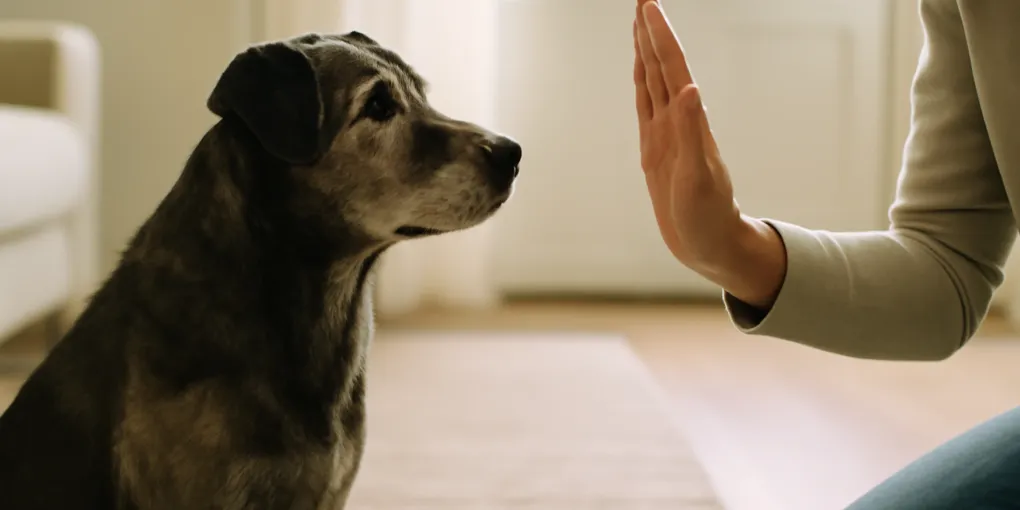
| Stop/wait | Flat palm facing the dog | Pause, then release with a second cue |
| Bed | Point to the mat | Reward on the mat |
| Outside | Point to the door, then leash | Calm exit through the same door |
Teach in a quiet room while the dog is already looking at you. Show the cue once, help the dog complete the easy behavior, and reward immediately. Five one-minute sessions are more useful than one long drill for an older dog with fatigue or pain.
A flashlight can be conditioned as a visual orientation cue indoors: brief light on the floor, reward when the dog looks toward you. Never flash into the eyes or use it near stairs. Outside, ambient light and line of sight are unreliable, so it is not an off-leash recall system.
Decide whether a vibration cue fits
A vibration collar is optional, not a correction device. It can serve as a remote “turn and look” cue when the dog is awake but facing away. Choose a vibration-only product rather than a shock collar with vibration as an extra mode.
Condition it at the lowest perceptible setting. Check Vibration Only Dog Collar No Shock on Amazon.
- With the dog relaxed beside you, activate one brief vibration.
- Immediately deliver a high-value reward, whether or not the dog looks up.
- Repeat three to five times, then stop.
- In later sessions, reward the head turn toward you.
- Add distance only after the dog shows a relaxed, reliable orientation response.
Stop if the dog freezes, scratches frantically, hides, or shows escalating anxiety. Never vibrate a sleeping dog, use continuous stimulation, or use the collar to punish barking. Remove it when unsupervised and inspect thin senior skin for pressure or rubbing.
Fix the four high-risk places
Exterior doors
Add a baby gate or closed interior door between the dog and frequently opened exterior doors. Clip the leash on before opening the final barrier. Visitors and delivery drivers should not be expected to remember that a quiet dog cannot hear the doorway.
Keep an engraved collar tag and microchip registration current. Check Engraved Slide On Dog Id Tag on Amazon. A tracker may help locate an escaped dog, but it does not replace a physical barrier and can lose power or coverage.
Stairs and dark routes
Use secure gates at stairs the dog does not need. Add nonslip runners and low-glare motion lights on the route to water, bed, and the toilet exit. Check Battery Motion Sensor Night Lights Stairs on Amazon. Avoid loose mats and lights that switch on directly into the dog’s eyes.
Sleep areas
Approach where the dog can see you. If the dog is deeply asleep, step firmly nearby to create floor vibration, turn on a room light, or touch the edge of the bed before the body. Teach children never to hug or grab a sleeping dog. Startle is a reflex, not defiance.
Roads and open spaces
Use a standard leash attached to a well-fitted harness or collar. Retractable lines create delayed control near bicycles, traffic, and other dogs. Off-leash exercise belongs only inside a secure fence that has been checked for gaps and gates.
A seven-day transition plan
Days 1 and 2: Schedule the exam, inventory sound-dependent routines, update identification, and block the riskiest exterior door.
Days 3 and 4: Teach “look at me” and “come” hand signals indoors. Ask every household member to use the same gestures.
Day 5: Add nonslip lighting and sleeping-area approach rules. Practice clipping the leash before a door opens.
Day 6: If needed, begin positive conditioning to a vibration-only cue at close range. Do not combine this with a stressful outing.
Day 7: Run a safety rehearsal: doorbell, visitor, nighttime toilet trip, fenced-yard recall, and emergency leash pickup. Fix the point where the plan still depends on the dog hearing.
Two details matter especially for a deaf senior dog: a recall gesture only works when the dog is looking, and waking by touching the torso can trigger a defensive startle. Physical barriers and a bedding-first wake cue solve those specific failures.
Sources
- Merck Veterinary Manual, Deafness in Dogs: https://www.merckvetmanual.com/dog-owners/ear-disorders-of-dogs/deafness-in-dogs
- Louisiana State University School of Veterinary Medicine, BAER testing and deafness: https://www.lsu.edu/vetmed/deafness/index.php
- American Animal Hospital Association, 2023 Senior Care Guidelines for Dogs and Cats: https://www.aaha.org/resources/2023-aaha-senior-care-guidelines-for-dogs-and-cats/
Frequently Asked Questions
- Age-related inner-ear degeneration is common, but wax, infection, inflammation, a foreign body, medication effects, and other disease can also reduce hearing. A veterinarian should examine a new change.
- Use a leash or a securely fenced area. A dog who cannot hear traffic, another dog, or a recall cue has less warning and no reliable auditory stop signal.
- Avoid a sudden grab. Create floor vibration by stepping nearby, switch on a light, or gently touch the bedding first, then reward calm orientation.