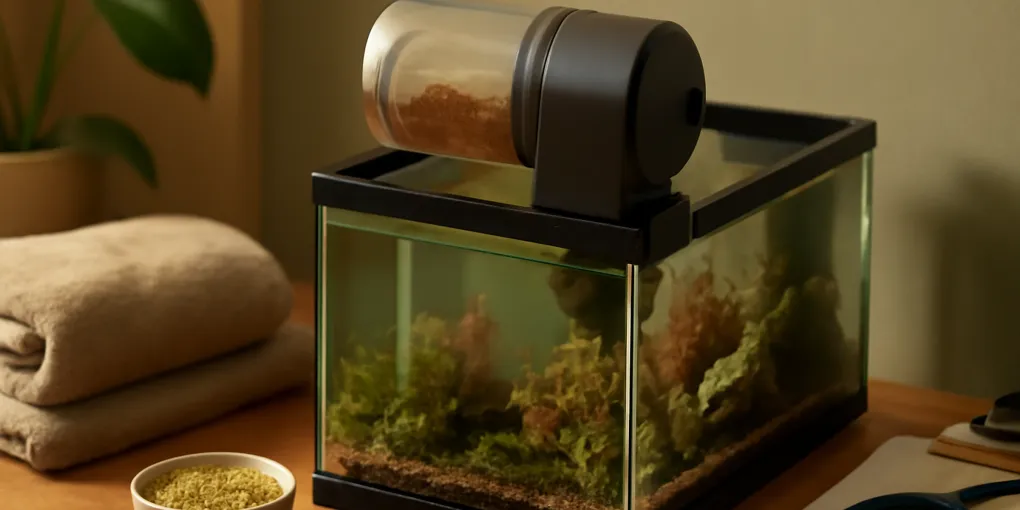
Do Automatic Fish Feeders Work for Weekend Trips? Evidence, Failure Modes, and Safer Setup
Evidence ExplainerQuick picks
Eheim Everyday Fish Feeder
★ Top pick- Best for: Dry flake or pellet feeding on short trips
- Check first: Humidity and tiny flakes can still clump if the feeder sits over heavy condensation.
- Rationale: The rotating drum format is widely used and can be tested with small portions before travel.
Fish Mate F14 feeder
- Best for: Pre-portioned dry food when exact meal size matters
- Check first: Small compartments may not fit bulky sticks or larger community-tank portions.
- Rationale: Individual compartments make it harder to accidentally dump a huge drum opening into the tank.
Aquarium water test kit
- Best for: Checking ammonia and nitrite before and after a trip
- Check first: A test kit does not replace stable filtration or conservative feeding.
- Rationale: Feeding mistakes show up as water-quality problems before they look like a gadget problem.
Short answer
Automatic fish feeders can work for a weekend trip if they are tested, mounted securely, loaded with dry food that does not clump, and set to feed less than you normally would. They fail when owners install them the night before travel, use damp flakes, leave a wide-open drum, or skip water testing.
If you keep delicate fish, newly added fish, fry, medicated fish, or a tank with recent ammonia or nitrite problems, solve stability before adding a feeder. Our aquarium quarantine tank setup protocol explains why new-fish timing and water quality matter more than gadgets.
Weekend feeder risk score
| Criterion | Weight | Score | Why it matters for trip feeding |
|---|---|---|---|
| Research | 30% | 8.0 | The core issue is water quality, not gadget convenience. |
| Evidence quality | 25% | 7.5 | Direct feeder trials are limited, but aquarium husbandry guidance consistently warns against overfeeding. |
| Value | 20% | 8.0 | A $25 to $45 feeder can protect a trip only if it prevents, rather than causes, excess food. |
| User signals | 15% | 8.5 | Weekend-trip owners need a simple decision rule under time pressure. |
| Transparency | 10% | 8.5 | The article separates adult-fish fasting, feeder testing, and water-quality monitoring. |
| Composite | 8.0/10 | Useful for short trips when paired with conservative feeding. |
What usually goes wrong
The most common failure is not starvation. It is too much food. Extra food decomposes, drives ammonia risk, and can overwhelm a filter that was stable under normal feeding.
Other common failures:
- Flakes absorb humidity and clump in the drum.
- A feeder opening is set too wide.
- The mount shifts and dumps food onto the lid instead of the water.
- The owner tests over a sink but never tests on the real tank.
- A fish sitter adds food on top of the automatic schedule.
Recommended products for weekend feeding
Eheim Everyday Fish Feeder
This is the default search path for many owners because the drum is simple and widely available. It fits dry flakes, granules, and small pellets, but you need to test the opening with your exact food. Fine flakes can pour faster than expected.
Best use: a stable community tank where one small daily feed is enough while you are away.
Search Amazon for Eheim Everyday Fish Feeder
Fish Mate F14 feeder
The compartment design is useful when you want each feeding to be pre-portioned. That reduces the risk of a drum opening being bumped too wide. It is less convenient for bulky foods.
Best use: small community fish where meal size matters and the food fits cleanly in compartments.
Search Amazon for Fish Mate F14 automatic fish feeder
Water test kit
A test kit is not optional travel gear if the tank is new, heavily stocked, or recently changed. Check ammonia and nitrite before you leave. Check again when you return. The feeder is only successful if the water stays safe.
Search Amazon for aquarium ammonia nitrite test kit
Species and food-format checks
The feeder decision changes by species. A lightly stocked planted community tank with adult tetras is different from a tank with fry, grazing herbivores, goldfish with heavy waste output, or fish recovering from disease. If the animals normally receive tiny meals several times per day, test whether one conservative dry-food drop is acceptable before assuming a weekend schedule is harmless.
Food shape matters as much as the feeder brand. Uniform pellets dispense more predictably than mixed flake sizes. Freeze-dried cubes, algae wafers, and soft foods can jam, swell, or land as one oversized clump. If your fish need those foods, a pre-measured human sitter may be safer than forcing the food through a vacation feeder.
Weekend setup protocol
Five to seven days before travel, decide whether the fish need feeding at all. Many healthy adult community fish tolerate a short fast, while young, tiny, or high-metabolism species may need a plan.
Three days before travel, run the feeder over a white plate at the exact schedule you intend to use. Count how much food lands each time. Reduce the portion until it looks smaller than a normal home feeding.
Two days before travel, mount it on the tank while you are home. Watch where the food lands. Keep it away from heavy filter splash, lid condensation, and open air gaps where fish can jump.
The day before travel, do not perform a huge disruptive cleaning. Confirm the filter is running, temperature is stable, and water tests are acceptable.
When no feeder is the safer choice
Skip the feeder for a weekend if the tank is stable, the fish are healthy adults, and the usual feeding routine is not medically necessary. A short fast can be safer than an untested machine.
Also skip automatic feeding if you use wet, frozen, gel, or refrigerated foods unless the device is designed for that format. Most simple vacation feeders are dry-food tools.
Automatic fish feeder FAQ
Should I ask a friend to feed instead?
Only if the friend can follow pre-measured portions. Put each meal in a labeled container and hide the full food jar. Human overfeeding is as risky as feeder overfeeding.
Do bettas need a weekend feeder?
Many healthy adult bettas can handle a short fast, but individual health and temperature matter. If you use a feeder, test tiny portions because betta pellets are easy to overdispense.
Can an automatic feeder replace daily care on a long vacation?
No. For longer trips, you still need someone to check power, temperature, filter flow, water level, and livestock condition.
Sources
- University of Florida IFAS Extension: Stress and fish health
- University of Florida IFAS Extension: Ammonia in aquatic systems
Frequently Asked Questions
- Many healthy adult fish can handle a short fast better than an overfed tank, but species, age, health, temperature, and stocking level matter. Research your fish before deciding.
- Often no. Blocks can dissolve unpredictably and add material to the water. A tested feeder or a short fast is usually easier to control.
- Run it over paper or a cup for several days, then on the tank while you are home for at least a few feeding cycles.